

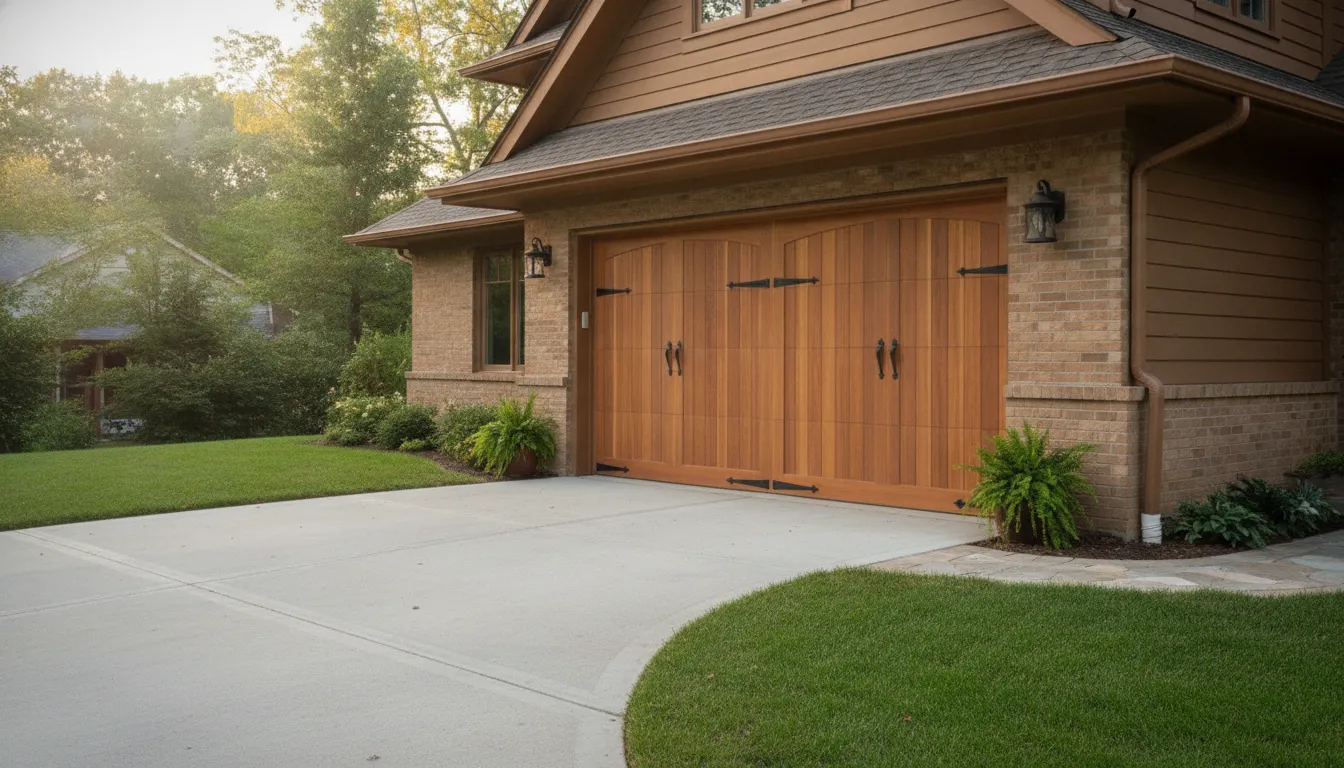
Western red cedar garage doors bring real wood grain, natural color, and practical decay resistance to the front of a home. Cedar is a strong starting point for a custom door, but the finished result also depends on the grade, joinery, panel design, finish, hardware, and exposure.
This guide explains how to evaluate Western Red Cedar for a custom garage door, from knotty versus clear boards to stain selection and climate-specific care. For a broader comparison of cedar, alder, cypress, Douglas fir, mahogany, and other options, read our guide to wood garage door materials.
Why Western Red Cedar Garage Doors Are a Practical Choice
Short answer: Western red cedar is a practical garage-door material because it is relatively light, workable, visually distinctive, and naturally resistant to decay and insects. Those qualities support custom panel designs, but durable results still depend on proper joinery, sealed edges, a suitable exterior finish, balanced hardware, and regular inspection.
Western red cedar is widely used in exterior woodworking because it combines several useful properties in one material. Its straight grain and warm color give a door a clear connection to the wood itself. Its relatively low density can also be useful when a large moving door must be designed and balanced correctly. The USDA Forest Products Laboratory describes the species in its Western redcedar technical sheet.
That combination works across several design languages. Cedar can support the broad panels and decorative trim of a carriage house door. The horizontal proportions of an overhead door, or the clean lines of a Modern Landscape design. It can also be coordinated with a matching custom wood entry door when the facade calls for a consistent material and stain direction.
Custom sizing starts with the opening
Every Craft Doors USA door is custom-built for its opening rather than selected from a standard size. Before a wood species is finalized, the design should account for opening dimensions, headroom, side clearance, window placement, panel proportions, operating style, and the surrounding architecture. A cedar door may be built as an overhead door compatible with a garage door opener or as a swing-out barn-style door with a jamb kit and heavy-duty hinges.
Cedar is a material choice, not a complete weather system
Cedar's natural resistance is one part of the performance equation. Roof overhangs, drainage, bottom-edge clearance, weatherstripping, finish coverage, and inspection all matter. Horizontal ledges and exposed end grain can still collect water. Good craftsmanship uses cedar's properties as a foundation, then protects the complete door assembly from avoidable moisture.
What Natural Properties Help Western Red Cedar Garage Doors Perform?
Short answer: The main performance advantages are low relative weight, workable grain, and natural extractives in the heartwood that help resist decay and insect activity. These properties give cedar useful outdoor margin, but they do not make an exposed garage door maintenance-free or immune to moisture, sunlight, impact, or poor drainage.
For a custom garage door, lower density can make material selection and hardware balancing especially important. The goal is not simply to make the lightest possible door. The frame, panels, struts, hinges, tracks, rollers, and opener must be selected as one operating system. A properly balanced assembly moves predictably and places less unnecessary strain on its components.
Rot and insect resistance help at exposed surfaces
Cedar's natural extractives can help the heartwood resist decay and insect activity. That is useful at broad panel faces and other exposed areas, particularly when the finish and construction keep water from lingering. It does not repair a leak, replace a protective coating, or make unsealed end grain safe from repeated wetting.
Grain and softness influence appearance
Cedar has a comparatively soft surface. It is workable for custom fabrication, but sharp impacts can leave marks more readily than they would on a harder species. That softness is part of the material's character, not a defect. It means the board layout, trim details, hardware placement, and maintenance expectations should be planned with the home's use in mind.
The grain also gives designers a useful range. Clear, straight-grained boards can create a quieter surface across a modern panel. Knotty boards create stronger variation and a more rustic face. In either case, the door should be designed around the boards rather than treated as a blank sheet that will look identical in every section.
Contact Our Sales and Design Specialists
Knotty Cedar vs. Clear Cedar: Which Grade Fits the Door?
Short answer: Knotty cedar shows visible knots and stronger natural variation, while clear cedar presents a more uniform surface with fewer prominent knots. Neither is automatically the better grade. Choose based on the home's architecture, the desired amount of board character, the pattern of the door, and how the finish should read from the street.
| Consideration | #2 Knotty Western Red Cedar | Clear Cedar |
|---|---|---|
| Visual character | Visible knots and varied grain create a rustic, natural face. | More uniform boards create a calmer, cleaner face. |
| Design fit | Works well with carriage house, barn, and traditional patterns. | Works well with modern, minimal, or refined panel layouts. |
| Finish behavior | Variation remains visible and makes each board read differently. | Color tends to look more even across the door face. |
| Selection priority | Board placement and knot character should be reviewed in the design. | Grain direction and consistent tone become more important. |
Choose knotty cedar for visible character
#2 Knotty Western Red Cedar is Craft Doors USA's standard wood offering. Its knots and grain variation are the reason many homeowners choose cedar over a uniform synthetic surface. In a carriage house design, natural marks can reinforce the look of a hand-built door and give broad panels more visual depth.
Knotty cedar suits homes with stone, brick, timber, or other materials that already contain natural variation. The approved shop drawing is the right point to discuss board character and pattern placement. A clear plan makes the knots part of the design instead of an afterthought.
Choose clear cedar for a quieter surface
Clear cedar reduces the number of prominent knots and lets grain direction carry more of the appearance. It can suit a Modern Landscape door with horizontal tongue and groove paneling, or a project where the garage door should coordinate closely with a matching entry door. Clear cedar still changes with light and weather. It simply starts with a more even visual field.
Craft Doors USA also offers an approximately 85% knot-free cedar selection. The right grade depends on the design language, the preferred amount of natural variation, and how the garage door relates to the rest of the facade.
How Does Western Red Cedar Take Stain and Finish?
Short answer: Western red cedar accepts exterior stain while keeping its grain visible. The final color depends on the boards, knots, surface preparation, application method, exposure, and selected stain. Semi-transparent finishes show more natural variation, while more opaque finishes create a more even color field without removing the need for edge and joint protection.
Real wood does not produce a perfectly uniform color across a large door. Cedar's starting tone varies from pale honey to deeper brown and red notes. Knots and grain absorb finish differently, so two boards treated with the same stain can show modest variation. That variation is expected when the goal is to preserve the material's character.
Choose a finish for the actual exposure
Finish selection should consider direct sun, wind-driven rain, reflected heat from paving, nearby trees, roof protection, and the direction the door faces. Transparent and semi-transparent stains allow more grain to show. A more opaque finish shifts the balance toward color consistency. Neither choice eliminates the need to inspect the door's edges, joints, trim, and bottom rail.
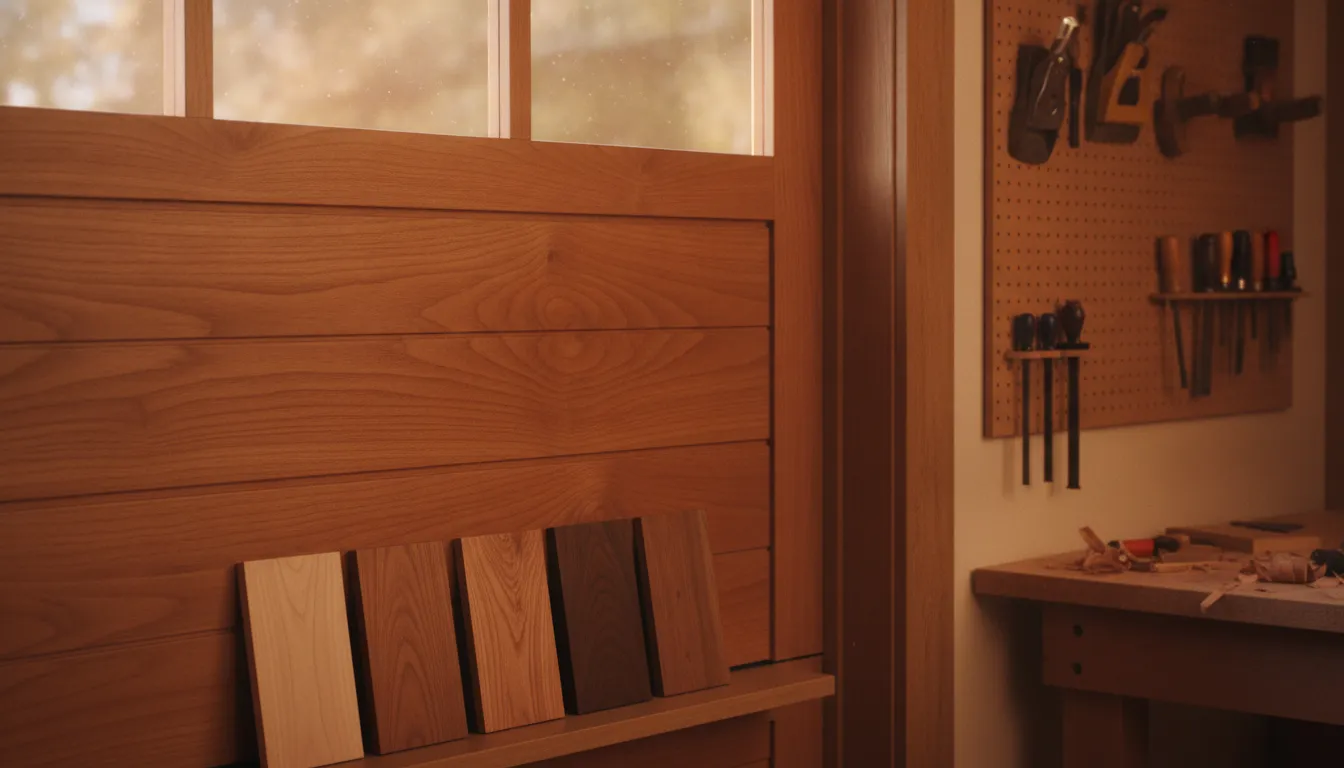
Craft Doors USA offers more than 19 semi-transparent stain colors and can work toward a custom match. Review the stain color collection alongside siding, trim, masonry, and the entry door. A small sample should be viewed in natural light because indoor lighting can change the apparent warmth and depth of the color.
Preparation and application shape the result
A consistent finish begins with clean, properly prepared wood. Sanding affects absorption, and edges, end grain, joints, and trim require the same attention as broad panel faces. Uneven coverage can appear later as color variation or premature weathering.
Craft Doors USA hand-applies selected stain or paint as part of its nine-step craftsmanship process, then uses heat-lamp curing and an inspection for finish consistency. The sequence also includes shop drawing approval before production. This matters because the finish is applied to a specific door design, not to a generic panel that will be cut down later.
How Should You Maintain Western Red Cedar Garage Doors?
Short answer: Maintain cedar garage doors by keeping water and debris away, checking the finish and bottom edge regularly, and addressing peeling, cracking, loose hardware, or persistent leaks early. Climate and sun exposure affect the inspection routine. Cleaning gently and repairing the cause of moisture is more useful than repeatedly coating over a problem.
Inspect the door at least seasonally and look more closely after severe weather. Focus on the bottom edge, horizontal trim, joints, window areas, and places where hardware meets the wood. Those details experience more water, movement, and handling than a broad protected panel face.
- Keep the bottom edge clear: Move leaves, mulch, stored items, and other wet debris away from the door.
- Watch the finish: Look for peeling, cracking, chalking, fading, or exposed wood.
- Check water paths: Confirm that weatherstripping and drainage keep water from sitting against the panels.
- Clean gently: Use a soft brush and mild soap, then allow the surface to dry before refinishing.
- Investigate damage: Have damaged boards, loose hardware, or persistent leaks evaluated before applying another coat.
Humid climates: keep moisture moving
In humid regions, shade and airflow can be as important as wood species. Dense landscaping close to the door can slow drying. Sprinklers should not spray the panels, and the bottom edge should not remain in wet debris. Inspect joints and lower trim regularly because these areas experience repeated wetting and drying.
Coastal climates: inspect edges and hardware
Salt air, wind-driven rain, and strong sun can place more demand on exterior finishes and metal hardware. Rinse surface deposits with clean water when appropriate, avoid harsh cleaners, and inspect fasteners and hinges for corrosion. Pay special attention to exposed edges and places where wind-driven moisture can enter a joint.
High-altitude and sunny climates: plan for ultraviolet exposure
Bright sun can fade or weather a finish faster than a shaded elevation. South- and west-facing doors may need closer observation than protected elevations. Early maintenance is simpler than waiting until the wood is visibly dry or the finish has failed across a large area.
More detail about the complete build sequence is available on Craft Doors USA's craftsmanship process page. Cedar, finish, joints, weatherstripping, drainage, and operating hardware all contribute to the final result.
What Should Buyers Confirm Before Choosing Western Red Cedar Garage Doors?
Short answer: Before approving a cedar garage door, confirm the operating style, wood grade, board character, panel layout, window and hardware locations, finish direction, and exposure-specific care. Reviewing these details before production reduces avoidable surprises and makes the finished door fit the architecture as well as the opening.
- Define the opening: Measure the opening and identify the intended operating system.
- Select the visual character: Decide whether the design should emphasize knots or a more even grain.
- Review the shop drawing: Confirm panel layout, trim, windows, hardware, and proportions.
- Compare stain samples: View the samples against the home's exterior in natural light.
- Confirm weather details: Discuss finish coverage, weatherstripping, drainage, and a realistic inspection routine.
These questions keep the design conversation concrete. They also prevent a common mistake: choosing a wood species from a photograph without considering how the finished door will face weather and relate to the architecture. A custom cedar door should look intentional from the driveway and remain serviceable at its edges, joints, and hardware.
Craft Doors USA hand-builds custom wood garage doors in Newton, North Carolina, including carriage house, overhead, Modern Landscape, and Wishbone or Herringbone styles. The company ships nationwide within the continental United States, and matching custom wood entry doors are also available. Learn more about the hands-on approach on the Craft Doors USA story page.
Contact Our Sales and Design Specialists
Frequently Asked Questions
Is cedar a good wood for a garage door?
Yes. Western red cedar is light, workable, visually distinctive, and naturally resistant to decay and insects. It still needs sound construction, a suitable exterior finish, proper weatherstripping, and regular inspection. Cedar is a practical material choice, not a promise that a garage door will never weather.
Is red cedar the same as Western Red Cedar?
People often use red cedar as shorthand, but Western Red Cedar specifically refers to the species commonly used in exterior woodworking in North America. When comparing doors, ask which wood species and grade are actually included rather than relying on a general color name.
What is the difference between knotty and clear cedar?
Knotty cedar has visible knots and stronger natural variation. Clear cedar has fewer prominent knots and a more consistent surface. Knotty boards suit rustic and traditional designs, while clear boards can suit modern or more uniform panel layouts. The better choice depends on the home's architecture and the appearance you want.
How should cedar garage doors be maintained?
Inspect the finish, bottom edge, joints, hardware, and weatherstripping seasonally. Keep sprinklers and wet debris away from the door, clean gently, and address peeling, cracking, loose hardware, or persistent moisture early. Climate, sun exposure, and finish type determine how often additional maintenance is needed.
Start With the Right Cedar Door Design
The right cedar door balances the look you want with the exposure your home presents. Craft Doors USA can help you compare cedar grades, stain direction, operating styles, and design details before production begins.